
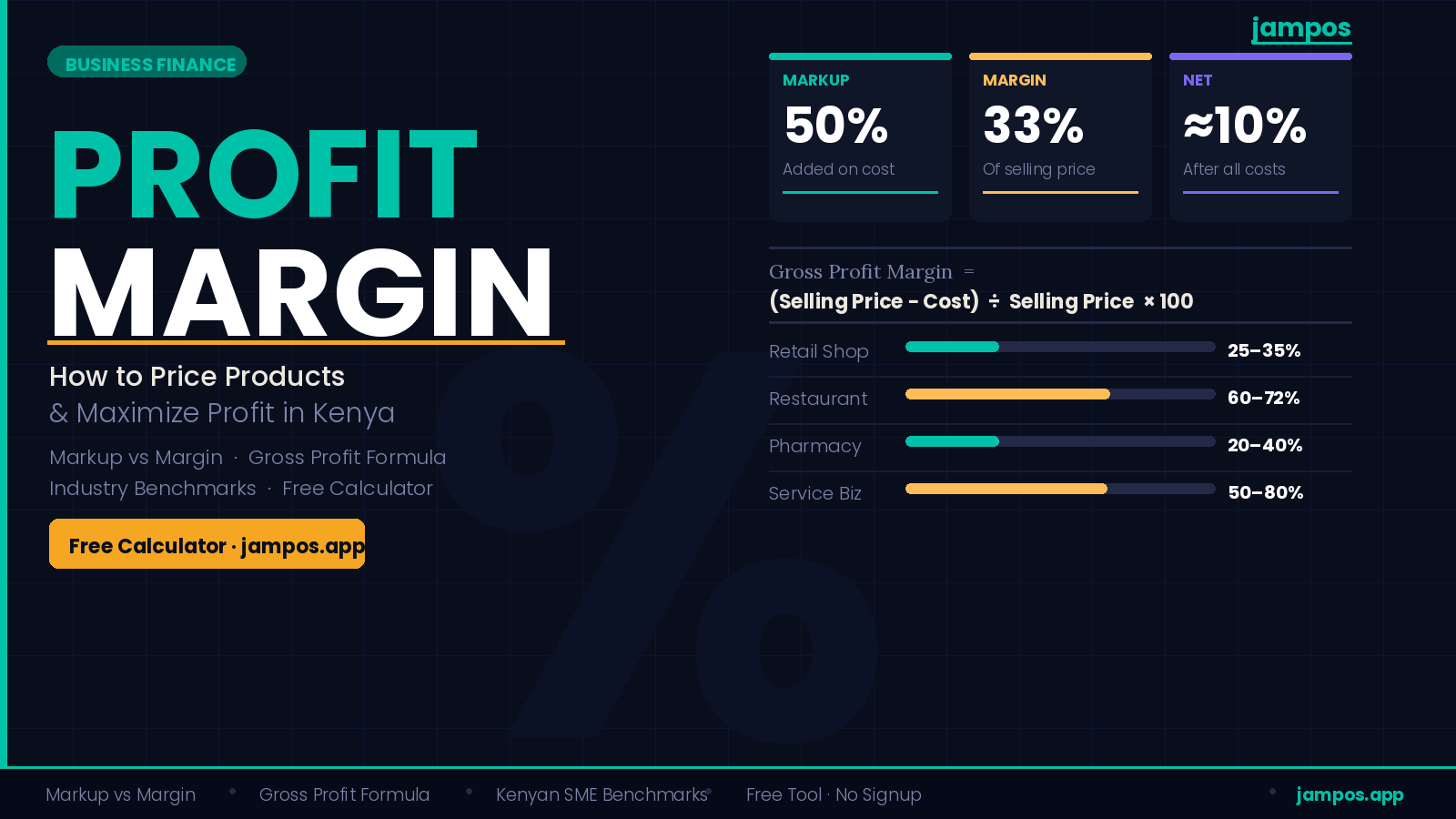
Why Pricing is the Most Overlooked Profit Driver in Kenyan Business
Most business owners focus on selling more to make more money. While volume matters, pricing is a far more powerful lever — and most Kenyan SMEs are leaving significant money on the table because of pricing mistakes that are completely avoidable.
Consider this: if your business makes KES 500,000 in monthly sales at a 15% net margin, you take home KES 75,000. If you increase your prices by just 5% without losing a single customer, your net margin jumps to roughly 20% and you take home KES 100,000 — a 33% income increase with zero additional effort. That is the power of correct pricing.
Markup vs Margin: The Difference That Changes Everything
This is the most common and most costly confusion in Kenyan business finance. Markup and margin are both expressed as percentages, both involve cost and selling price, but they measure completely different things and lead to very different pricing decisions.
What Is Markup?
Markup is the percentage you add ON TOP of your cost price to arrive at your selling price. Markup Formula: Markup % = ((Selling Price − Cost) ÷ Cost) × 100 Example: You buy a product for KES 200 and sell it for KES 300. Markup = ((300 − 200) ÷ 200) × 100 = 50% markup Markup answers the question: 'How much above cost am I selling this?' Markup is useful when you want to set a selling price starting from your cost.
What Is Profit Margin?
Margin (also called profit margin or gross margin) is the percentage of your SELLING PRICE that is profit. Margin Formula: Margin % = ((Selling Price − Cost) ÷ Selling Price) × 100 Example: Same product — cost KES 200, selling price KES 300. Margin = ((300 − 200) ÷ 300) × 100 = 33.3% margin Margin answers the question: 'Of every shilling I receive, how much is actual profit?' Margin is what banks, investors, and accountants use. It is the true measure of profitability.
Quick Conversion: Markup to Margin and Back
Converting Markup to Margin: Margin = Markup ÷ (1 + Markup) Example: 50% markup → 50 ÷ 150 = 33.3% margin Converting Margin to Markup: Markup = Margin ÷ (1 − Margin) Example: 33.3% margin → 33.3 ÷ 66.7 = 50% markup Common Reference Table: 20% markup = 16.7% margin 25% markup = 20% margin 33% markup = 25% margin 50% markup = 33.3% margin 67% markup = 40% margin 100% markup = 50% margin Or simply use the free Jampos Profit Margin Calculator and skip the arithmetic entirely.
The Profit Margin Formula: Step-by-Step for Kenyan Businesses
There are three profit margin formulas every business owner should understand. Each measures a different layer of your business profitability.
1. Gross Profit Margin
What it measures: Profitability after subtracting only the direct cost of goods sold (COGS). Formula: Gross Profit = Revenue − Cost of Goods Sold Gross Profit Margin % = (Gross Profit ÷ Revenue) × 100 Kenyan Example — Retail Shop: A hardware shop in Nakuru buys a box of nails for KES 120 and sells it for KES 200. Gross Profit = 200 − 120 = KES 80 Gross Profit Margin = (80 ÷ 200) × 100 = 40% This means 40 cents of every shilling from nail sales goes toward covering overhead and generating net profit. Gross margin is your starting point — it must be high enough to cover all other business costs and still leave net profit.
2. Operating Profit Margin
What it measures: Profitability after subtracting both COGS and operating expenses (rent, salaries, utilities, etc.). Formula: Operating Profit = Gross Profit − Operating Expenses Operating Margin % = (Operating Profit ÷ Revenue) × 100 Kenyan Example — Retail Shop: Same hardware shop has monthly revenue of KES 300,000, COGS of KES 180,000, and operating expenses (rent KES 25,000, staff KES 40,000, utilities KES 8,000, M-PESA fees KES 2,000) totaling KES 75,000. Gross Profit = 300,000 − 180,000 = KES 120,000 Operating Profit = 120,000 − 75,000 = KES 45,000 Operating Margin = (45,000 ÷ 300,000) × 100 = 15% This is the margin most business owners should be monitoring monthly. It tells you whether the business model actually works after real-world costs.
3. Net Profit Margin
What it measures: Final profitability after ALL expenses including taxes, loan repayments, and any other costs. Formula: Net Profit = Operating Profit − Taxes − Loan Repayments − Other Costs Net Profit Margin % = (Net Profit ÷ Revenue) × 100 Kenyan Example: Same hardware shop has a KES 10,000 monthly loan repayment and KES 5,000 in taxes. Net Profit = 45,000 − 10,000 − 5,000 = KES 30,000 Net Profit Margin = (30,000 ÷ 300,000) × 100 = 10% Net margin is what you actually take home. For most Kenyan retail SMEs, a healthy net margin is between 8% and 20% depending on industry.
What Is a Good Profit Margin in Kenya? Industry Benchmarks
Profit margin benchmarks vary significantly by industry. Comparing your margin to the wrong benchmark leads to false confidence or unnecessary panic. Here are realistic gross margin targets for common Kenyan business types:
Retail Shops and Supermarkets
Typical gross margin: 15% to 35% Typical net margin: 3% to 8% Retail is a volume business with relatively thin margins. A general shop in Nairobi's CBD targeting 20% gross margin is performing well. Specialty retail (beauty products, electronics accessories, stationery) can achieve 30–40% gross margins. Supermarkets and high-volume grocers often operate on 10–20% gross margins but compensate with scale. Pricing target: Aim for minimum 20% gross margin across your product range, with higher margins on faster-moving items to compensate for thin margins on competitive staple products.
Restaurants, Cafés, and Food Service
Typical gross margin: 60% to 75% (food cost should be 25–40% of selling price) Typical net margin: 5% to 15% Food businesses have high gross margins but significant overhead (kitchen staff, fuel/gas, packaging, wastage). The rule of thumb: food cost should never exceed 35% of your menu price. If your chicken stew costs KES 130 to prepare (ingredients only), your minimum selling price should be KES 130 ÷ 0.35 = KES 371, rounded to KES 380–400. Pricing target: Price each dish so food cost is 28–35% of selling price, giving you 65–72% gross margin to cover overhead and profit.
Pharmacies and Medical Supplies
Typical gross margin: 20% to 40% Typical net margin: 8% to 15% Pharmacies in Kenya operate in a regulated environment where certain drug prices have reference points. Margins on branded medications are typically 15–25%, while margins on generic drugs, supplements, and medical consumables can reach 40–60%. Building your margin on higher-markup products while staying competitive on common medications is the standard approach. Pricing target: Achieve a blended gross margin of at least 30% across your product mix.
Wholesale and Distribution
Typical gross margin: 8% to 20% Typical net margin: 2% to 6% Wholesale operates on thin margins compensated by very high volume. The business model only works with excellent inventory turnover, minimal stock holding costs, and tight operational efficiency. If you are running wholesale with less than 10% gross margin, your cost structure needs urgent review. Pricing target: Minimum 12% gross margin to ensure net profitability after operating costs.
Service Businesses (Salons, Repair Shops, Consulting)
Typical gross margin: 50% to 80% Typical net margin: 15% to 30% Service businesses have the highest potential margins because the primary 'cost' is skilled labour time, which is more controllable than physical goods. A hair salon charging KES 800 for a service with KES 150 in product cost has a 81% gross margin. Net margin after rent and staff salaries typically lands at 20–35% for well-run service businesses. Pricing target: Price services so material cost is below 25% of the service fee, and ensure your per-hour effective rate covers all overhead plus profit.
How to Use the Free Jampos Profit Margin Calculator
The Jampos Profit Margin Calculator is the fastest way to calculate your margin, markup, and correct selling price — no formulas needed, no spreadsheets, no accounting knowledge required. Here is exactly how to use it for different business scenarios.
Mode 1: Calculate Margin from Cost and Selling Price
Use this when: You already have a selling price and want to know your actual margin. Step 1: Enter your cost price (what you pay for the item) Step 2: Enter your selling price (what you charge the customer) Step 3: The calculator instantly shows your: Gross profit (in KES), Gross profit margin (%), Markup percentage Example: You sell a phone case for KES 450. You buy it for KES 280. Result: Gross profit = KES 170, Margin = 37.8%, Markup = 60.7% This is useful for auditing your current prices. Many business owners discover they have been operating on 15% margins when they thought they were on 30%.
Mode 2: Calculate Selling Price from Cost and Target Margin
Use this when: You have a new product and want to price it to hit a specific margin target. Step 1: Enter your cost price Step 2: Enter your target profit margin % Step 3: The calculator gives you the exact selling price to achieve that margin Example: You are stocking a new cooking oil brand that costs you KES 185 per litre. You want a 30% margin. Result: Selling price = KES 264.28 → round to KES 265 This eliminates all guesswork from new product pricing. You know from day one that every unit you sell delivers exactly your target margin.
Mode 3: Calculate Cost from Selling Price and Target Margin
Use this when: You operate in a price-sensitive market and need to know your maximum allowable cost. Step 1: Enter your selling price (fixed by market conditions) Step 2: Enter your target margin % Step 3: The calculator shows the maximum cost you can accept Example: Rice sells at KES 180 per kg in your market. You need a 25% margin. What is the maximum you can pay your supplier? Result: Maximum cost = KES 135 per kg This is a powerful negotiation tool. You walk into supplier meetings knowing your hard ceiling — and you can tell a supplier exactly what price you need for the deal to make business sense.
Real Kenyan Business Pricing Scenarios: Worked Examples
Theory is only useful when applied to real situations. Here are complete pricing walkthroughs for four common Kenyan business types.
Scenario 1: Retail Grocery Shop in Mombasa
Mama Aisha stocks her shop with 200 products. She has been pricing by 'adding KES 20 or 30' to whatever she buys, with no consistent system. Her rent is KES 18,000, staff KES 25,000, utilities KES 5,000 monthly. Step 1 — Calculate her required gross margin: Monthly overhead = 18,000 + 25,000 + 5,000 = KES 48,000 Target net profit = KES 20,000 Total needed above COGS = KES 68,000 Step 2 — Estimate monthly revenue: If monthly revenue is KES 250,000, she needs KES 68,000 ÷ KES 250,000 = 27.2% gross margin minimum. Step 3 — Price each product: Sugar (cost KES 140/kg) → target 28% margin → selling price = KES 140 ÷ (1 − 0.28) = KES 194.4 → KES 195 Cooking oil 1L (cost KES 185) → target 28% → selling price = KES 257 → KES 260 Rice 1kg (cost KES 130) → target 28% → selling price = KES 181 → KES 180 By running every product through the calculator with a consistent 27–30% margin target, Mama Aisha transforms random pricing into a system that reliably covers costs and delivers profit.
Scenario 2: Restaurant in Nairobi (Westlands)
Chef James runs a lunch spot serving office workers. His rent is KES 45,000, four staff cost KES 80,000, utilities and gas KES 15,000. His monthly overhead is KES 140,000 and he targets KES 50,000 net profit. Needed monthly gross profit = KES 190,000 Estimated monthly revenue (80 customers/day × 22 days × average KES 350) = KES 616,000 Required gross margin = 190,000 ÷ 616,000 = 30.8% — but food businesses target 65%+ gross margin to absorb the additional costs. The 30% represents net margin target. Pricing a dish — Chicken and rice: Ingredient cost: Chicken KES 90, rice KES 25, vegetables KES 20, oil/seasoning KES 15 = Total KES 150 Target food cost ratio: 30% of selling price Required selling price = KES 150 ÷ 0.30 = KES 500 At KES 500, food cost is 30%, gross margin is 70%, giving plenty of room to cover staff, rent, utilities, and still reach his KES 50,000 profit target.
Scenario 3: Pharmacy in Kisumu
Dr. Otieno runs a community pharmacy. He wants to price consistently across 800 products without calculating each one manually. His approach using the calculator: Generic medications (high competition): Target 20% margin — customers price-compare Branded supplements and vitamins: Target 40% margin — less price sensitivity Medical consumables (bandages, gloves, syringes): Target 45% margin — convenience purchase Personal care products: Target 35% margin — moderate competition By segmenting his 800 products into four pricing tiers and using the calculator to price each tier consistently, he achieves a blended margin of approximately 33% — well above the 25% minimum needed to run profitably. This approach takes two hours to implement but permanently fixes his pricing system.
Scenario 4: Hardware Store in Eldoret
John stocks 2,000 SKUs from roofing nails to power tools. He struggles with pricing because products range from KES 5 items to KES 15,000 power tools. His tiered margin approach: High-value items (above KES 5,000): 15% margin — lower margin but high absolute profit per unit Mid-range items (KES 500–5,000): 25% margin — solid margin, moderate volume Low-value consumables (below KES 500): 35–50% margin — customers don't price-compare small items Nail box costs KES 80 → 40% margin → sell at KES 133 → rounded to KES 135 Hammer costs KES 650 → 25% margin → sell at KES 867 → rounded to KES 870 Power drill costs KES 8,500 → 15% margin → sell at KES 10,000 The blended margin across his range lands at approximately 28%, making the business sustainably profitable despite competitive pressure on high-value items.
Hidden Costs You Must Include When Calculating True Margin
Many Kenyan businesses calculate margin based only on the wholesale purchase price. This underestimates true cost and inflates apparent margin — often by 5–15%. Here are the hidden costs that must factor into your true cost base:
M-PESA Transaction Fees
If a significant portion of your sales are via M-PESA, transaction fees reduce your effective revenue. M-PESA withdrawal fees (if applicable) and merchant service fees mean your net receipts are slightly below the stated selling price. For a business with KES 400,000 in monthly M-PESA sales, fees can total KES 4,000–8,000 monthly — money that must be accounted for in your margin calculation. Rule: Add 1–2% to your cost base to account for M-PESA fees, or factor it into your pricing as a fixed uplift.
Freight, Transport, and Delivery Costs
If you collect stock from Nairobi's Gikomba, Eastleigh, or Industrial Area and you are based in another town, transport cost is a real cost of goods. A trip costing KES 3,000 to collect KES 50,000 worth of stock adds 6% to your effective cost. Rule: Divide your transport cost by the value of goods collected and add that percentage to each item's cost before applying your margin.
Packaging and Bags
Plastic bags, paper bags, boxes, and wrapping are real costs that eat into margin. For businesses selling fresh produce or food, packaging can represent 3–8% of product cost. Rule: Track monthly packaging spend and divide by monthly units sold to get a per-unit packaging cost. Add this to COGS.
Wastage, Expiry, and Shrinkage
For businesses selling perishables, wastage is a cost that must be priced into margins. If 10% of your fresh produce spoils before sale, your effective cost on the 90% you sell is higher. Rule: If your wastage rate is 10%, divide your cost by 0.90 before applying margin. A vegetable that costs KES 50 with 10% expected wastage has an effective cost of KES 55.55 for pricing purposes.
How Jampos POS Tracks Your Margins Automatically — Product by Product
Calculating margins manually or with a standalone calculator is valuable for setting prices. But once your business is running, you need real-time visibility into which products are actually delivering their target margins — and which are quietly underperforming. This is where Jampos POS makes manual tracking completely unnecessary.
Automatic Margin Tracking Per Product
When you add products to Jampos POS with their cost price and selling price, the system automatically calculates and displays the margin for every product in your inventory. You can see at a glance which products are above or below your target margin, sorted by category, supplier, or margin band.
Real-Time Profit Reports
Every sale in Jampos generates a profit data point. Your daily, weekly, and monthly reports show not just revenue but actual gross profit — by product, by category, by cashier, and by time period. You can see which hours of the day are most profitable, which products drive the most gross profit (not just the most revenue), and how your margins are trending over time.
Identify Your Most and Least Profitable Products
Many businesses discover surprising insights when they look at profit rather than revenue. A high-selling product with thin margins may contribute less profit than a slower-selling item with excellent margins. Jampos shows you both views simultaneously, allowing you to make informed decisions about which products to promote, reorder, or discontinue.
Cost Price Alerts and Margin Protection
When supplier prices change (a common reality in Kenya given import costs and exchange rate fluctuations), Jampos tracks the change and flags products whose margins have dropped below your threshold. Rather than discovering six months later that your margins have been eroded, you get immediate visibility to adjust pricing or renegotiate with suppliers.
Pricing Strategy Tips for Kenyan Market Conditions
Kenyan markets have specific dynamics that influence how you should think about pricing beyond the basic margin formula.
Price in Psychologically Friendly Numbers
Kenyan consumers respond to prices ending in 0, 5, 9, or 99. A product priced at KES 197 feels cheaper than KES 200. A product at KES 2,995 moves faster than KES 3,000. After calculating your margin-correct price, round to the nearest psychologically friendly number — usually within 1–3% of the calculated price, which is unlikely to materially affect your margin. Exception: In B2B sales, round numbers (KES 5,000, KES 10,000) often signal professionalism and simplicity. Use round numbers for invoice-based transactions.
Handling Price Sensitivity on Staples
In price-sensitive markets, consumers compare prices on common staples — sugar, flour, cooking oil, basic grains. On these items, you may need to accept thinner margins (10–15%) to remain competitive. The strategy is to offset this with higher margins on items customers do not price-compare — impulse purchases, convenience items, branded goods, and specialty products. A well-managed product mix achieves a healthy blended margin even when individual product margins vary widely.
Account for Seasonal Cost Fluctuations
Kenya's agricultural calendar significantly impacts input costs for food businesses. Fresh produce prices spike during dry seasons and crash during harvest. A restaurant that prices based on peak-season costs will overprice during harvest, losing customers. One that prices based on low-season costs will lose money when costs rise. Best practice: Price based on your average cost across seasons, or create two seasonal menus — one for high-cost periods and one for low-cost periods. Jampos allows you to update prices instantly across all products when seasonal adjustments are needed.
The Power of Bundle Pricing
Selling items as bundles allows you to blend margins strategically. A combo meal that combines a high-margin drink (80% margin) with a moderate-margin food item (60% margin) creates an attractive customer price while achieving a blended margin that exceeds selling each item separately. For retail shops, bundle promotions (buy 3 for KES X) can be priced to improve total transaction value while appearing to offer customer savings — when the bundle margin actually exceeds the individual item margin.
Common Questions About Profit Margin in Kenya
What is a good profit margin for a small shop in Kenya?
For a general retail shop (groceries, household goods, electronics accessories), a healthy gross margin is 25–35% and a healthy net margin is 8–15% after all overheads. If your net margin is below 5%, your business is vulnerable to any cost increase or sales dip. Below 0%, you are losing money even when busy — a situation more common than most business owners realize before they start tracking margins carefully.
How do I calculate margin when I buy in bulk and sell individually?
Calculate your unit cost first. If you buy a sack of 50kg rice for KES 5,500, your cost per kg is KES 110. Add your transport cost (say KES 500 for the trip, covering 200kg total = KES 2.50 per kg) and wastage (2% = KES 2.25 per kg). True cost per kg = KES 114.75. Apply your 28% target margin: selling price = KES 114.75 ÷ (1 − 0.28) = KES 159.38 → sell at KES 160 per kg.
Should I use the same margin for every product?
No. A tiered margin strategy works better in practice. Use higher margins on low-competition, impulse, or convenience items, and accept thinner margins on highly competitive staples. What matters is your blended average margin across all sales — this should consistently hit your profitability target even if individual products vary.
How does inflation affect my margin targets?
Inflation directly erodes margins if you do not adjust prices. When the cost of goods rises 10% due to inflation but your selling prices remain unchanged, your margin compresses immediately. In Kenya's inflationary environment, review your cost prices and margins at minimum quarterly, or whenever you receive a new supplier invoice. Jampos alerts you when cost prices change, making margin monitoring automatic.
Is the profit margin calculator free to use?
Yes — the Jampos Profit Margin Calculator is completely free with no sign-up required. You can calculate margins for unlimited products without creating an account. It is designed as a free business tool for any Kenyan entrepreneur, whether or not you use Jampos POS.
Take Control of Your Profitability Starting Today
Pricing is not guesswork. It is a system — and once you have the right system in place, every product you sell is working correctly for your business rather than against it. The difference between businesses that struggle and businesses that grow is rarely about how much they sell. It is almost always about how well they price what they sell.
Start with the free Jampos Profit Margin Calculator today. Run your top 20 products through it and see where your real margins land. You will almost certainly find products you have been underpricing — and that discovery alone can add meaningful profit to your business without selling a single additional unit.
Questions about pricing, margins, or how Jampos POS tracks profitability for your business? 📞 Call/WhatsApp: 0700548080 🌐 Website: www.jampos.app 📧 Email: jamming@jampos.co